Tube mill process control and digital setup records
A setup sheet is useful only when it describes the product, material, tooling, machine state, measurement method, and process condition that produced the recorded result. A list of stand positions without that context can reproduce yesterday's numbers while failing to reproduce yesterday's process.
Originally published in the ASTM A513 handbook (astma513.com), where specification-scoped A513 reference material remains.
Build one versioned record connecting product requirements, incoming material, current tooling geometry, machine readiness, setup targets, startup actuals, stable-running actuals, quality results, deviations, and corrective learning. Never overwrite the last-good state.
Why tube-mill knowledge disappears
Many plants have fragments of the truth in different places:
- The ERP knows the order and material
- The drawing controls product requirements
- Tooling drawings contain nominal geometry
- The tooling crib knows which rolls are present
- Maintenance knows machine condition
- A spreadsheet contains setup targets
- Operators know practical adjustments
- Quality retains first-piece and test results
- Scrap records contain an incomplete symptom code
When those records are not linked, the plant cannot reliably distinguish product variation from material, tooling, machine, setup, measurement, or documentation variation.
The objective is not to digitize every paper field at once. It is to connect the minimum information required to reproduce and improve a stable run.
The eight-record model
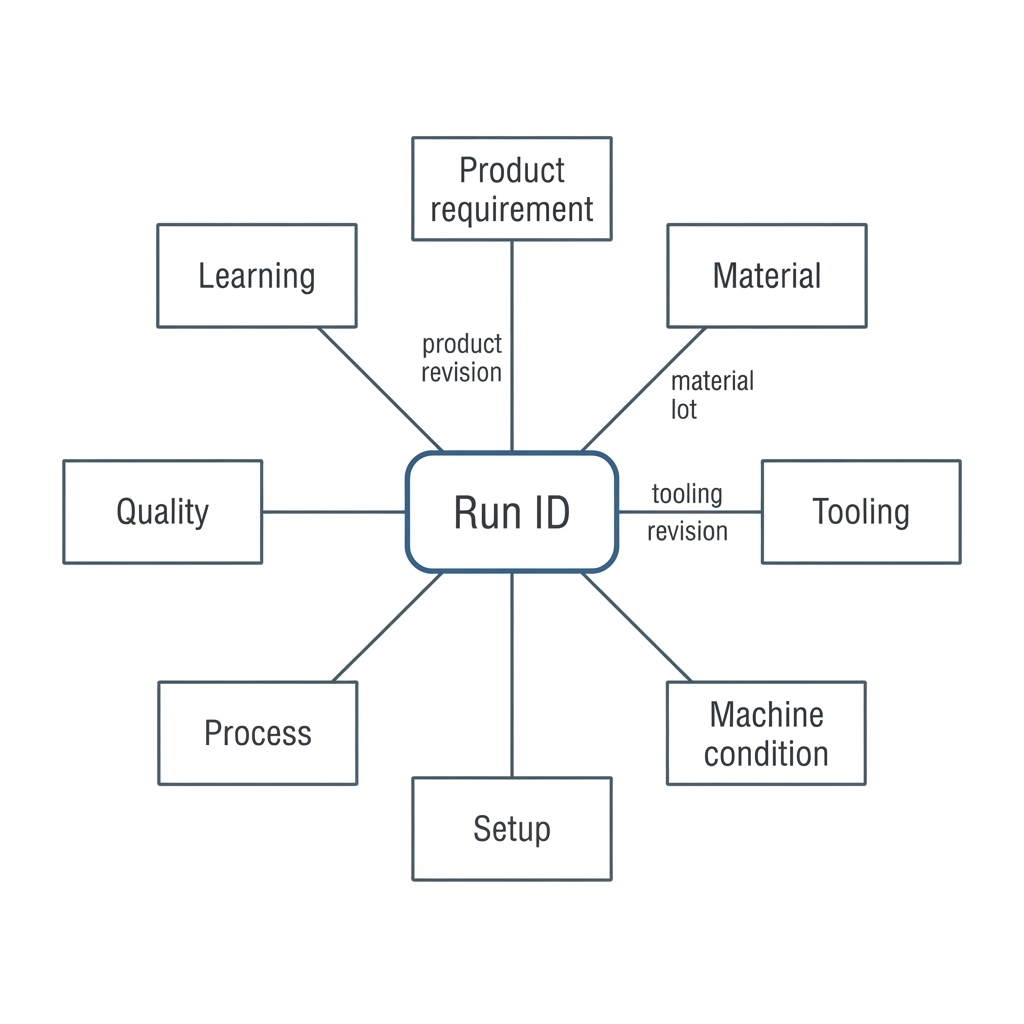
The eight records join through run ID, product revision, material lot, tooling revision, mill, and approval.
| Record | Core question |
|---|---|
| Product requirement | What tube was ordered, to which revision and acceptance basis? |
| Material | Which physical material entered the run, and what were its measured incoming properties? |
| Tooling | Which tooling geometry and lifecycle state contacted the product? |
| Machine condition | Was the mill mechanically capable of holding the intended setup? |
| Setup | What targets and physical positions were used? |
| Process | What did the line actually do during startup and stable production? |
| Quality | What product evidence supported release and ongoing control? |
| Learning | What symptom, cause, correction, and approved standard change were recorded? |
The eight records and the core question each answers
What each record captures
Each record has a minimum field set. The details below are recommendations, not a fixed schema — the right fields depend on the plant, quality system, and customer requirements.
Product requirement
Internal product ID; customer and drawing identifiers handled per access policy; drawing and specification revision; ASTM standard edition and manufacturing type; material/grade and condition; shape and nominal dimensions; controlled characteristics and tolerances; tests, certification, and supplementary requirements; seam, surface, end-use, and fabrication constraints; approved deviations; effective date and approver.
Store requirements as versioned data. Do not silently update the historical run when a drawing changes.
Material
Supplier; coil, heat, and lot identity; certificate reference; grade or chemistry designation; nominal and actual thickness; actual strip width; hardness or mechanical properties where available and relevant; slit-edge condition, burr orientation, camber, crown, and surface; coating or lubricant-relevant information; receiving or release status.
The system should allow a quality event to be compared across coils and a coil transition to be compared with a process change.
Tooling
The setup must reference the tooling that actually ran — not only the nominal roll-set number. Capture roll-set and individual-roll identities; drawing and revision; station, orientation, and assembly; material, construction, and heat-treatment reference; original and current relevant dimensions; regrind cycle and modification history; shim and spacer state; measured wear, pickup, or damage; status and remaining-life decision; inspection/approval date.
See the tube roll tooling lifecycle guide on this site for the complete model.
Machine condition
The most precise setup target is unreliable when the stand or shaft moves. Record the most recent relevant condition of foundation, base, stand, and restraint integrity; shaft dimensions and runout where controlled; bearing condition and applicable preload/endplay evidence; lead screw or adjustment backlash; centerline and pass-line alignment; weld-box, guide, straightener, and exit support condition; drive, cooling, scarf, and measurement-system readiness; and open maintenance or deviation conditions.
The record should not imply that a machine is fully qualified because a checklist was completed. Link findings, measured results, applicable limits, corrective work, and approval.
The setup record: three states, never one
A useful setup record contains three different states:
- Target — approved starting value from the controlled setup.
- Startup actual — value or condition used while establishing the first acceptable product.
- Stable-running actual — value or condition observed after the process is demonstrably stable.
Do not collapse these into one field. Their differences reveal drift, compensating adjustments, and whether the saved target remains realistic.
Setup fields may include entry position and guide state; stand positions and gaps; side-pass and fin settings; pass-by-pass dimensions; weld-box and straightener settings; spacer and shim references; line and section drive settings; heat, pressure/upset, cooling, and scarf references; the approved threading and startup sequence; and reason-coded departures from the target. Every dimension should link to its location, method, units, and gauge or source.
Process and quality records
Capture actual process conditions at defined moments rather than logging an uncontrolled stream without context. Useful states include startup; first acceptable piece; stable run; coil transition; speed change; tooling or maintenance intervention; alarm or quality event; and shutdown or end of run. Depending on the line, the record can include speed, section RPM, motor load, weld process variables, cooling, temperature, cutoff, and selected equipment condition. Store timestamps and time synchronization so quality samples can be correlated with the process state.
The quality record connects first-piece approval; in-process dimensional results; weld tests and examination; surface, straightness, twist, and geometry results; sample location and frequency; gauge and method; certificate and release status; nonconformance and containment; and disposition or deviation.
Never overwrite a failed or questionable result with the retest. Preserve both and record why the retest was performed.
The learning record
The learning record turns troubleshooting into controlled knowledge. Minimum fields:
- Symptom and first detectable stage
- Affected run, material, tooling, machine, and setup versions
- Evidence preserved
- Immediate containment
- Hypotheses considered
- Verified cause or “cause unconfirmed”
- Correction and authorization
- Before/after measurement
- Validation run and sample
- Documents or training changed
- Owner and completion date
- Approval for any new standard setup
A correction is not a new standard merely because one run succeeded.
Version-control rules
- Never overwrite the last-good setup
- Create a new revision for material, tooling, machine, product, or process changes that affect reproducibility
- Record why the revision exists and who approved it
- Separate design dimensions from wear-compensating settings
- Preserve the setup version actually used on each run
- Make deviations time-bound and product-specific unless formally incorporated
- Prevent unapproved drafts from becoming operator defaults
- Retain a human-readable comparison between revisions
Minimum viable implementation
Do not wait for a full digital twin. A crawl-walk-run implementation can begin with five controlled identifiers: run or job ID, product/drawing revision, material heat/coil/lot, tooling-set revision and regrind state, and setup revision.
Crawl
- Standardize naming and IDs
- Digitize one last-good setup for a high-value product family
- Link first-piece results and scrap reason to the run
- Capture tooling regrind and shim state
- Require reason codes for departures
Walk
- Add material actuals and machine-readiness records
- Add stable-running actuals and revision comparison
- Connect quality, maintenance, and tooling events
- Build dashboards for startup scrap, time to first good piece, and repeated adjustments
Run
- Ingest selected machine signals with synchronized timestamps
- Compare products, coils, tooling revisions, and process states
- Use statistical models only after definitions, measurement systems, and data completeness are controlled
- Preserve operator and engineer review for consequential decisions
High-value measures
- Time from last good piece to first good piece
- Startup scrap length, weight, and value
- Percentage of critical passes with recorded actuals
- Number of unplanned adjustments after first-piece approval
- Difference between target and stable-running actual
- Repeatability of first-piece dimensions by setup revision
- Tooling life and quality capability by material/gauge family
- Recurring defect by first detectable stage
- Corrective actions closed and verified on time
- Percentage of runs linked to product, material, tooling, setup, and first-piece identities
These measures should support action, not punish disclosure. If operators are penalized for recording variation, the system will receive cleaner data and a dirtier process.
Check whether a matching run is already on order at Tightsteel, our related digital warehouse for steel tube — or send the requirement and get a mill run scoped. Runs are planned mill production, not shelf stock; the producing mill and country of origin are disclosed to you before you’re bound to anything.
See what's on order → tightsteel.com/warehouse
Tightsteel is a related commercial venture. See /disclosures.